Google Images:
Sunday, May 25, 2014


Wednesday, May 14, 2014
Google Apps in the Classroom

There are several advantages to
using Google apps in the classroom. Google apps can be used to enhance the
students’ learning experience as well as enhance professional development.
Google docs is a great tool that provides opportunities for powerful
collaboration. This can be especially helpful when students engage in writing
assignments. With Google docs, “students
are able to see another student writing at that very moment. Editing can take
place at the moment words are placed on the page,” (Olah, 2014, pg. 1). Thus,
students can collaborate with each other throughout the entire writing process.
Students can easily see the writing of their classmates and provide helpful
comments. Google docs allows students to receive instantaneous feedback from
their classmates as well as from their teacher.
In addition to this, using Google apps removes restraints that are
otherwise present. For instance, students can collaborate and interact, “with an
ever-expanding circle of their peers, regardless of geographical location,” (Cruz, 2011). Students are no longer limited because of their geographical location. Instead,
students can use Google apps to communicate, collaborate and learn with other
learners from all over the world. Not only do Google Apps expand student
collaboration, but it also eliminates the issue of losing papers, documents and
presentations. The work that students do with Google Apps is all saved to the
cloud. Their work can be accessed at any time from any place or any device.
This is a huge benefit for students. Furthermore, Google Apps expands
educational opportunities to students who may have challenges that make it
difficult to participate in a traditional educational setting. This can include
students who are going back to school at an older age or students who are
disabled. When Google Apps are used, an educational experience become easily
accessible to all students regardless of personal challenges.
Google
Apps have advantages for professional development as well. Educators can use
Google docs to communicate and collaborate with each other in real-time. They
can instantaneously edit and comment on notes that are being taken. This allows
each teacher to contribute his/her ideas. Also, Google Apps can be used to
provide professional development opportunities for teachers. These apps would
be free, compared to other professional development opportunities that would
cost money. In addition to this, teachers can easily share information with
each other. School calendars, unit plans, lesson plans and class lists are some
of the things that can easily be shared with other teachers in the school.
Google Docs provides an easy and convenient way to share this information and
allow it’s members to make changes as necessary. Essentially, Google Apps has
so much to offer and it should be used by students and teachers.
References:
Cruz, L. (2011). How
Cloud Computing is Revolutionizing Education. The Network:
CISCO.
Retrieved on May 13, 2014 from http://newsroom.cisco.com/feature- content?articleId=460910
Olah, D. (2014). Module
Seven: Productivity Applications: Google Apps. Southern New
Hampshire
University. pg. 1-4.
Google Image:
http://www.digitaltrends.com/wp-content/uploads/2010/12/google-apps-sphere-of-apps.jpg
Google Image:
http://www.digitaltrends.com/wp-content/uploads/2010/12/google-apps-sphere-of-apps.jpg
Wednesday, April 30, 2014
Pros and Cons of Social Networking in Schools
What are the Pros and Cons of Social Networking in Schools?

There are both pros and cons associated with social
networking in schools. To begin with, many schools are hesitant to use social
networking sites in school for several different reasons. Schools are fearful
about the possibility of students interacting with strangers or potentially
dangerous people online. This is a real concern that needs to be taken
seriously. In addition to this, many schools are afraid of behavioral issues
that could take place as a result of social networking. Students could easily
engage in inappropriate conversations with other peers or other people online.
Also, schools are most likely weary of students posting or expressing
inappropriate, mean or disrespectful comments. It is true that with social
networking there is possibility that it could lead to dangerous experiences or
unacceptable uses.
However, the benefits that social networking has to offer
seems to greatly outweigh the concerns that schools may have. First of all, it
is important to recognize that the purpose of the Internet has changed over the
past few years. The Internet is no longer used simply for reading or
researching. Instead, people have the opportunity to contribute to the
information on the Internet and become active participants online. Thus, the
Internet is all about, “communities, participation and peering,” (Solomon,
2010, pg. 83). It is important for educators to recognize the change in the
Internet and understand that we must allow students to engage in social network
based learning experiences in order to provide students with the 21st
century skills that they will need in their futures. Students have to be given
the opportunity to practice becoming involved and engaged participants in this
online community. Furthermore, most of our students are already using and accessing
social networking sites. Therefore, I believe we should introduce these tools
to them in school, so that we can teach our students about digital citizenship
and about how to participate in social communities safely and responsibly. Another
positive aspect of using social networking in schools is that, “young people
are already engaged by Web 2.0 applications,” (Solomon, 2010, pg. 85). Since
our students are already interested in and excited about using various web 2.0
tools, it makes sense for schools to use them for learning. Essentially, if
schools use web 2.0 tools in the classroom, it will be much easier to get
students engaged in their learning experiences because they are already excited
about using that tool/application. Thus, it is evident that there are both pros
and cons to using social networking in schools. However, in my personal
opinion, I believe that the benefits of using social networking significantly
outweigh any concerns that educators may have.
References:
Solomon, G. and Shrum, L. (2010). Web 2.0 how-to for educators. International Society
for
Technology in Education.
Wednesday, April 9, 2014
Digital Citizenship
The Importance of Digital Citizenship

The video on a person’s Digital Dossier was intriguing. Although I had always been aware of the fact that our lives were digitally tracked, I had not previously thought about the extent in which that occurs. It is true that everyone has a digital dossier of their own and this begins before a person is even born. As the video points out, a person’s digital dossier begins with the first sonogram that is taken of the baby. Not only is that sonogram kept in medical records, but, it is likely that it is sent and shared with loved ones through various digital forums. And, as we continue to grow, our digital dossier also grows with us. I imagine that the digital dossier of today’s students is much larger than mine ever was and it will continue to grow as our society becomes more technology-driven. A person’s digital dossier grows as people enter credit card information online, search on google and take their phones with them wherever they go. Not only does a person’s dossier follow them throughout their entire lives, but it also stays even after they have passed away. I believe that my own digital dossier has grown substantially since I was in high school. When I was a kid, my parents did not have the technology that is available today and therefore pictures and other information about me was not spread as easily or as quickly as it is today. However, as I got older, things like e-mail, texting, facebook, and picasa became much more commonly used. I know that my digital dossier grew as I began using social media, entering personal information online and using my smart phone. It is intriguing and somewhat frightening to think about a person’s digital dossier.
The video on a person’s Digital Dossier was intriguing. Although I had always been aware of the fact that our lives were digitally tracked, I had not previously thought about the extent in which that occurs. It is true that everyone has a digital dossier of their own and this begins before a person is even born. As the video points out, a person’s digital dossier begins with the first sonogram that is taken of the baby. Not only is that sonogram kept in medical records, but, it is likely that it is sent and shared with loved ones through various digital forums. And, as we continue to grow, our digital dossier also grows with us. I imagine that the digital dossier of today’s students is much larger than mine ever was and it will continue to grow as our society becomes more technology-driven. A person’s digital dossier grows as people enter credit card information online, search on google and take their phones with them wherever they go. Not only does a person’s dossier follow them throughout their entire lives, but it also stays even after they have passed away. I believe that my own digital dossier has grown substantially since I was in high school. When I was a kid, my parents did not have the technology that is available today and therefore pictures and other information about me was not spread as easily or as quickly as it is today. However, as I got older, things like e-mail, texting, facebook, and picasa became much more commonly used. I know that my digital dossier grew as I began using social media, entering personal information online and using my smart phone. It is intriguing and somewhat frightening to think about a person’s digital dossier.
In relation to this, it is important to recognize the fact
that today’s students are being exposed to technology at a much younger age
than ever before. Since our students have grown up in an environment where they
are constantly surrounded by technology it often seems as if they have an
innate sense about using technology. This is true and kids today are very
technologically savvy. However, that does not mean that they know and
understand how to appropriately and responsibly use technology. As it was
stated in one of the articles, “it is not enough to open the gate and let the
sheep out to wander aimlessly,” (Lindsay, 2012). Thus, we cannot provide
students with technology and expect them to know what to do. Instead, we need
to guide our students through this process and model appropriate and ethical
uses. As educators it is our “responsibility to teach students how to be
responsible digital citizens,” (Olah, Module two). When using technology today’s
students need to demonstrate respect for themselves and others, make ethical
decisions and have an understanding of safe and healthy choices. These concepts
must be encouraged and modeled by educators.
Furthermore, students must begin learning about digital
citizenship at a very young age. As soon as students are introduced to technology,
they should also be introduced to the responsibilities that go along with being
a digital citizen. Of course the information about digital citizenship should be
designed to appropriately match the developmental level of the students. It is
imperative for students to develop an understanding of digital citizenship at
an early age so that it can continue to grow as they get older.
On a personal note, I teach at a middle school and we spend time throughout the year teaching students about digital citizenship and what it means to be digitally responsible. Our students learn about how to identify things like credible vs. non-credible sources, scams and other signs of trouble online. In addition to this, students learn about using caution when revealing personal information about themselves. One of the topics that we focus heavily on is practicing responsible, moral and appropriate behavior on social media and other web 2.0 tools. I believe that this is an extremely important part of digital citizenship as most of our students are spending their free time on social media and other related sites. Below, you will see a poster that asks students to go through these seven questions before posting a photo online. This is something that we have hanging in our computer labs and our students responded really well to this. They seemed to understand the importance behind asking themselves these questions. Now, this does not mean that they will always do this. But, the hope is that it will be in the back of their minds and hopefully prevent them from posting anything that is truly disrespectful, unethical or inappropriate.
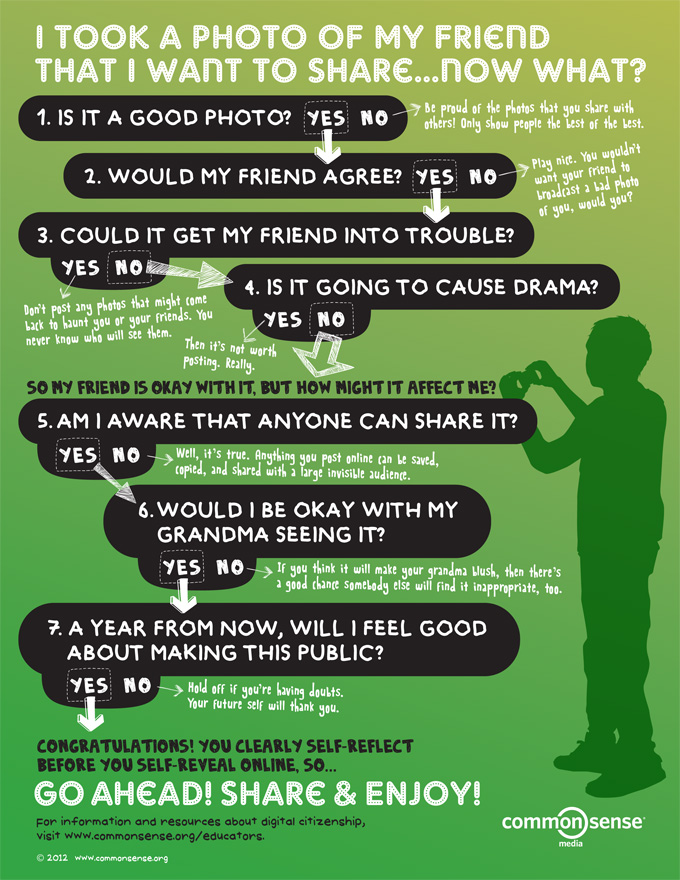
On a personal note, I teach at a middle school and we spend time throughout the year teaching students about digital citizenship and what it means to be digitally responsible. Our students learn about how to identify things like credible vs. non-credible sources, scams and other signs of trouble online. In addition to this, students learn about using caution when revealing personal information about themselves. One of the topics that we focus heavily on is practicing responsible, moral and appropriate behavior on social media and other web 2.0 tools. I believe that this is an extremely important part of digital citizenship as most of our students are spending their free time on social media and other related sites. Below, you will see a poster that asks students to go through these seven questions before posting a photo online. This is something that we have hanging in our computer labs and our students responded really well to this. They seemed to understand the importance behind asking themselves these questions. Now, this does not mean that they will always do this. But, the hope is that it will be in the back of their minds and hopefully prevent them from posting anything that is truly disrespectful, unethical or inappropriate.
References:
Olah, Dean. Module Two:
Digital Citizenship. Southern New Hampshire University. Retrieved on April 8, 2014.
Lindsay, J. and Davis, V. (2012). Navigate the Digital Rapids. ISTE. Retrieved on April 8, 2014 from: http://www.iste.org/learn/publications/learning- leading/issues/march-april-2010/navigate-the-digital-rapids
I took a photo of my friend that I want to share... now what? Photo retrieved on April 8, 2014 from: http://edutech4teachers.edublogs.org/files/2013/09/I-took-a-photo-of-my-friend-Poster-28eyklw.jpg
Digital Citizen Wiki/Font Page. Photo retrieved on April 9, 2014 from: https://tigerinfo.pbworks.com/f/1280058846/DC%20wordle.gif
I took a photo of my friend that I want to share... now what? Photo retrieved on April 8, 2014 from: http://edutech4teachers.edublogs.org/files/2013/09/I-took-a-photo-of-my-friend-Poster-28eyklw.jpg
Digital Citizen Wiki/Font Page. Photo retrieved on April 9, 2014 from: https://tigerinfo.pbworks.com/f/1280058846/DC%20wordle.gif
Monday, March 31, 2014

The role of a technology integration specialist is one that has evolved into a much more complex role over the past few years. In the past the teaching of technology related concepts used to fall solely on the technology teacher. However, as technology grows and becomes an integral part of our society, it is now important for technology to be integrated into all classrooms and learning environments. Therefore, the role of the technology integration specialist is now focused on developing strong relationships with administrators and teachers to guide the implementation of technology into the school. Technology integrationists are responsible for providing the appropriate support and guidance needed to develop technology-infused learning experiences. In addition to this, one of the responsibilities of the technology integration teacher is to find ways to bring new technology into the school and "to provide ways around lack of funding," (Olah, Module 1 Lecture). There will always be difficulty with the budget and it is important for the technology integration teacher to look for other creative ways to bring in new technology.
The role of the technology integrator becomes increasingly important in a school when thinking about today's students and the lives that they lead. Today's students spend most of their free time using various devices that connect them to the outside world. These devices range from iPods and Smartphones to iPads and laptops. These electronic devices are an integral part of their every day lives and they are not going away. One study even indicates that, "by 2013, there will be 1.82 billion smartphones," (Marshall, 2011, p. 1). Thus, it is in the best interest of our students to incorporate these devices into their educational experiences. As educators, we must accept these devices into the learning environment and show students how they can be used for educational purposes. Unfortunately, as stated in the Module 1 lecture, most schools require students to turn off and put away these devices as they enter into the school building. This is like asking students to step into a time machine and go backwards. It seems as if a much more logical approach to this would be to embrace these devices and to teach students how to use them for educational purposes. Yet, I believe that in order to do this, teachers need to be guided and supported by the technology integration teacher in their school as well as by the administration in their district.
As a result of this, it is evident that the role of the technology integration teacher is extremely important to the success that a school experiences with technology integration.
References:
Marshall, G. (2011, April 16). How smartphones and tablets are taking over. TechRadar. Retrieved on March 30, 2014 from: http://www.techradar.com/news/mobile-computing/how-smartphones-and-tablets-are-taking-over-942724
Olah, D. Module One: Reviewing the Role of the Technology Integration Specialist (State/National Standards) EDU 642. Southern New Hampshire University.
Technology Photo. Retrieved on April 4, 2014 from: http://blog.techimpact.org/wp-content/uploads/2013/10/Technology.jpg
Subscribe to:
Comments (Atom)