The Importance of Digital Citizenship

The video on a person’s Digital Dossier was intriguing. Although I had always been aware of the fact that our lives were digitally tracked, I had not previously thought about the extent in which that occurs. It is true that everyone has a digital dossier of their own and this begins before a person is even born. As the video points out, a person’s digital dossier begins with the first sonogram that is taken of the baby. Not only is that sonogram kept in medical records, but, it is likely that it is sent and shared with loved ones through various digital forums. And, as we continue to grow, our digital dossier also grows with us. I imagine that the digital dossier of today’s students is much larger than mine ever was and it will continue to grow as our society becomes more technology-driven. A person’s digital dossier grows as people enter credit card information online, search on google and take their phones with them wherever they go. Not only does a person’s dossier follow them throughout their entire lives, but it also stays even after they have passed away. I believe that my own digital dossier has grown substantially since I was in high school. When I was a kid, my parents did not have the technology that is available today and therefore pictures and other information about me was not spread as easily or as quickly as it is today. However, as I got older, things like e-mail, texting, facebook, and picasa became much more commonly used. I know that my digital dossier grew as I began using social media, entering personal information online and using my smart phone. It is intriguing and somewhat frightening to think about a person’s digital dossier.
The video on a person’s Digital Dossier was intriguing. Although I had always been aware of the fact that our lives were digitally tracked, I had not previously thought about the extent in which that occurs. It is true that everyone has a digital dossier of their own and this begins before a person is even born. As the video points out, a person’s digital dossier begins with the first sonogram that is taken of the baby. Not only is that sonogram kept in medical records, but, it is likely that it is sent and shared with loved ones through various digital forums. And, as we continue to grow, our digital dossier also grows with us. I imagine that the digital dossier of today’s students is much larger than mine ever was and it will continue to grow as our society becomes more technology-driven. A person’s digital dossier grows as people enter credit card information online, search on google and take their phones with them wherever they go. Not only does a person’s dossier follow them throughout their entire lives, but it also stays even after they have passed away. I believe that my own digital dossier has grown substantially since I was in high school. When I was a kid, my parents did not have the technology that is available today and therefore pictures and other information about me was not spread as easily or as quickly as it is today. However, as I got older, things like e-mail, texting, facebook, and picasa became much more commonly used. I know that my digital dossier grew as I began using social media, entering personal information online and using my smart phone. It is intriguing and somewhat frightening to think about a person’s digital dossier.
In relation to this, it is important to recognize the fact
that today’s students are being exposed to technology at a much younger age
than ever before. Since our students have grown up in an environment where they
are constantly surrounded by technology it often seems as if they have an
innate sense about using technology. This is true and kids today are very
technologically savvy. However, that does not mean that they know and
understand how to appropriately and responsibly use technology. As it was
stated in one of the articles, “it is not enough to open the gate and let the
sheep out to wander aimlessly,” (Lindsay, 2012). Thus, we cannot provide
students with technology and expect them to know what to do. Instead, we need
to guide our students through this process and model appropriate and ethical
uses. As educators it is our “responsibility to teach students how to be
responsible digital citizens,” (Olah, Module two). When using technology today’s
students need to demonstrate respect for themselves and others, make ethical
decisions and have an understanding of safe and healthy choices. These concepts
must be encouraged and modeled by educators.
Furthermore, students must begin learning about digital
citizenship at a very young age. As soon as students are introduced to technology,
they should also be introduced to the responsibilities that go along with being
a digital citizen. Of course the information about digital citizenship should be
designed to appropriately match the developmental level of the students. It is
imperative for students to develop an understanding of digital citizenship at
an early age so that it can continue to grow as they get older.
On a personal note, I teach at a middle school and we spend time throughout the year teaching students about digital citizenship and what it means to be digitally responsible. Our students learn about how to identify things like credible vs. non-credible sources, scams and other signs of trouble online. In addition to this, students learn about using caution when revealing personal information about themselves. One of the topics that we focus heavily on is practicing responsible, moral and appropriate behavior on social media and other web 2.0 tools. I believe that this is an extremely important part of digital citizenship as most of our students are spending their free time on social media and other related sites. Below, you will see a poster that asks students to go through these seven questions before posting a photo online. This is something that we have hanging in our computer labs and our students responded really well to this. They seemed to understand the importance behind asking themselves these questions. Now, this does not mean that they will always do this. But, the hope is that it will be in the back of their minds and hopefully prevent them from posting anything that is truly disrespectful, unethical or inappropriate.
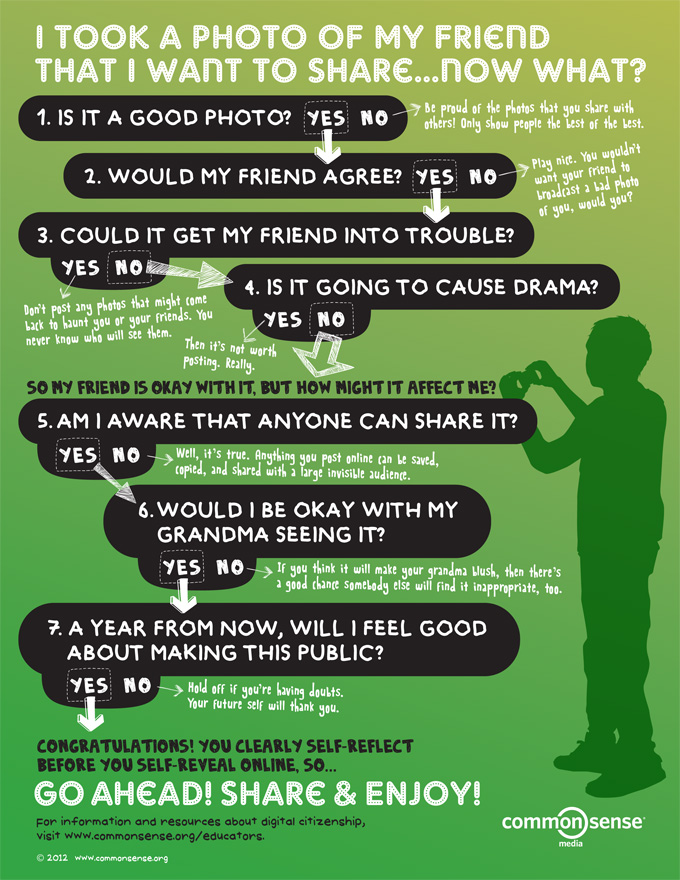
On a personal note, I teach at a middle school and we spend time throughout the year teaching students about digital citizenship and what it means to be digitally responsible. Our students learn about how to identify things like credible vs. non-credible sources, scams and other signs of trouble online. In addition to this, students learn about using caution when revealing personal information about themselves. One of the topics that we focus heavily on is practicing responsible, moral and appropriate behavior on social media and other web 2.0 tools. I believe that this is an extremely important part of digital citizenship as most of our students are spending their free time on social media and other related sites. Below, you will see a poster that asks students to go through these seven questions before posting a photo online. This is something that we have hanging in our computer labs and our students responded really well to this. They seemed to understand the importance behind asking themselves these questions. Now, this does not mean that they will always do this. But, the hope is that it will be in the back of their minds and hopefully prevent them from posting anything that is truly disrespectful, unethical or inappropriate.
References:
Olah, Dean. Module Two:
Digital Citizenship. Southern New Hampshire University. Retrieved on April 8, 2014.
Lindsay, J. and Davis, V. (2012). Navigate the Digital Rapids. ISTE. Retrieved on April 8, 2014 from: http://www.iste.org/learn/publications/learning- leading/issues/march-april-2010/navigate-the-digital-rapids
I took a photo of my friend that I want to share... now what? Photo retrieved on April 8, 2014 from: http://edutech4teachers.edublogs.org/files/2013/09/I-took-a-photo-of-my-friend-Poster-28eyklw.jpg
Digital Citizen Wiki/Font Page. Photo retrieved on April 9, 2014 from: https://tigerinfo.pbworks.com/f/1280058846/DC%20wordle.gif
I took a photo of my friend that I want to share... now what? Photo retrieved on April 8, 2014 from: http://edutech4teachers.edublogs.org/files/2013/09/I-took-a-photo-of-my-friend-Poster-28eyklw.jpg
Digital Citizen Wiki/Font Page. Photo retrieved on April 9, 2014 from: https://tigerinfo.pbworks.com/f/1280058846/DC%20wordle.gif

I liked the Wordle at the beginning of your post, nice touch. I think that putting the poster near the computers is a great idea. Like you said hopefully they will remember the poster when using social media outside of school. Maybe if it is in sight long enough it will be indelibly etched in their minds. At what grade level do students in your district start to learn about digital citizenship?
ReplyDeleteHi Steven,
ReplyDeleteHopefully seeing it day after day will help it stay in their minds!! I work at a Middle School that includes grades 5 -8. Here, we begin teaching students about Digital Citizenship in the fifth grade. I am not sure if they have had any exposure to digital citizenship prior to coming into 5th grade though. I would hope that they would have, but I am not sure about this. I will have to find out. Great question.
Hi Ellen,
ReplyDeleteLove the poster! I copied and pasted it into my blog as well. I agree that a person's digital dossier can be overwhelming and scary to even think about. And it is incredible what will be on there over a person's lifetime if they were born into the digital age. I know as an adult I reflect often on what I like, post, share online and I understand how this is so much more difficult for kids who do not have the life experience to always make good informed decisions. We just hope that they do and this poster is a great way to help them navigate their decisions. I think the earlier students learn responsible behavior online the better. If you grow up learning the good digital citizenship you accept that this how you behave. It has been so much more difficult for those kids and adults that were just thrown in and really had to figure it out themselves.
Ellen, I agree that digital citizenship needs to modeled by teachers. Teachers need to interact with students appropriately on wikis and blogs when monitoring projects and communicating throughout the task. This modeling, along with close monitoring will help the teacher keep students using technologies correclty and properly in the classroom. I have not had much trouble with students behaving inappropriately, although I haven't started using a class blog for students to communicate with each other yet. I haven't had the opportunity and not all of my students have technology available to them as of yet. I am very excited about use so much more technology in the future,
ReplyDeleteOh I almost forgot. I knew a teacher at the first school that I taught at. It was a middle school, and one of the teachers had befriended many of her students on facebook. I was told, through another teacher, that she is the one to ask if you want to know anything about students personal lives. She knows who is pregnant, who is dating who, who just broke up with who,. To me, this is not modeling appropriate behavior to students and she should have been reported for her actions.